
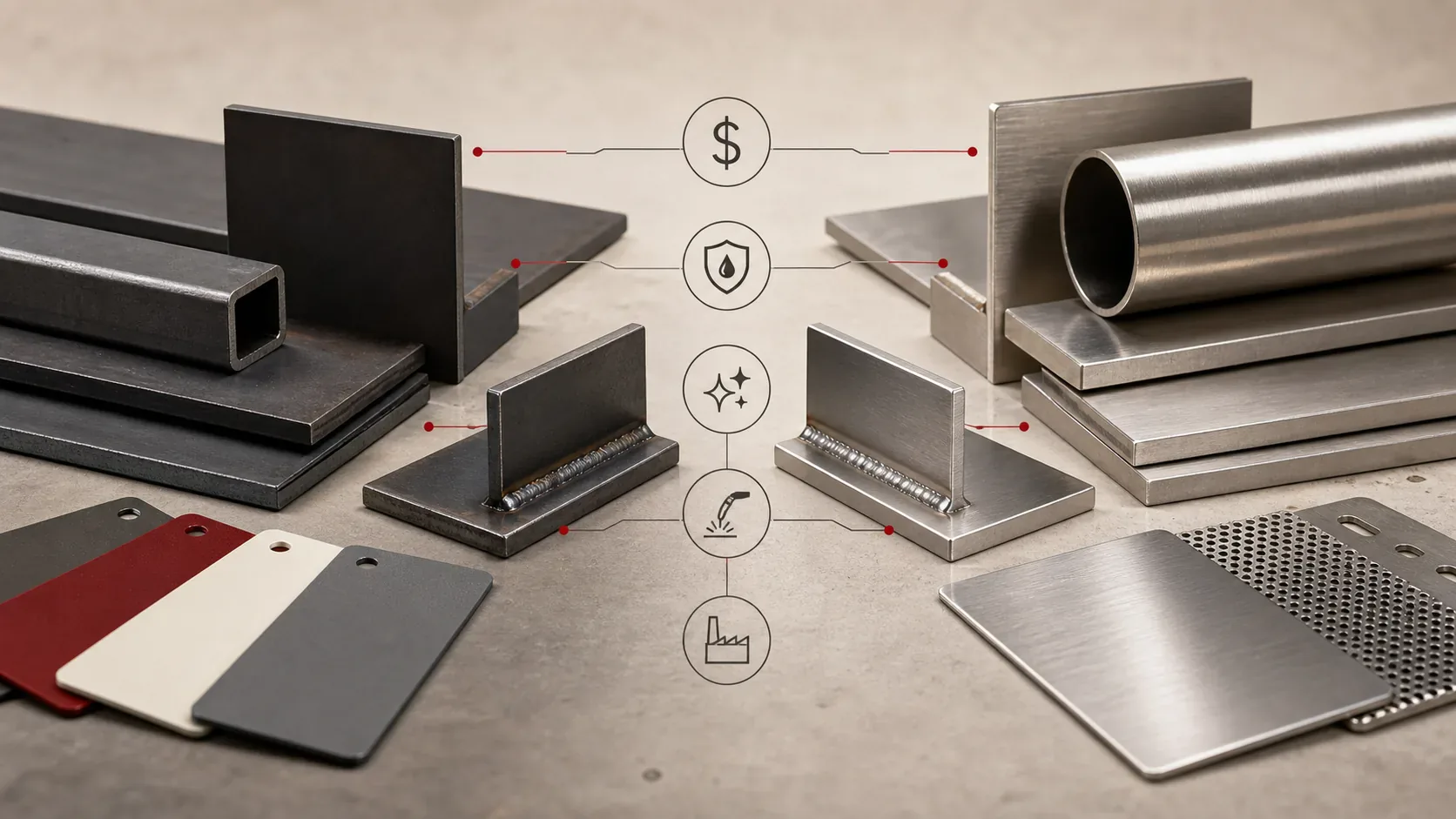
When does mild steel win?
Mild steel is the default for most metal fabrication work — and for good reason. It's cheaper than stainless by 2-4× per pound, easier to weld with MIG, easier to cut with both lasers and turret punches, and takes paint or powder coat well. For interior structural parts, painted enclosures, machine bases, equipment frames, and most production assemblies, mild steel is the right call.
The main weakness: corrosion. Bare mild steel rusts. Painted or powder-coated mild steel resists corrosion for years but eventually fails at scratched or chipped areas. If the part lives indoors and isn't exposed to wet processes, mild steel almost always wins.
When does stainless steel win?
Stainless steel wins anywhere corrosion, food contact, or aesthetic finish matters. The 304 grade is the workhorse — used for food-processing equipment, pharmaceutical fittings, architectural railings, and wash-down environments. The 316 grade adds molybdenum for marine and chloride-rich environments (pool pump rooms, coastal applications, chemical processing).
Stainless costs 2-4× more than mild steel per pound, welds slower (TIG, not MIG, for clean appearance), and is harder on cutting tools. But it lasts decades unpainted. For any part that will see wet, washed, or food-contact use, stainless is almost always the right call — the lifecycle cost is lower than rust-and-replace mild steel.
Cost comparison: by the numbers
Representative raw material planning ranges per pound (GTA fabrication, verify at quote time):
- Mild Steel A36 (hot-rolled): $0.80-$1.20/lb
- Mild Steel cold-rolled: $1.00-$1.40/lb
- Stainless 304: $3.50-$4.50/lb
- Stainless 316: $4.50-$6.00/lb
- Aluminum 6061: $3.00-$4.00/lb (for reference)
Finished part cost depends on more than material — laser time, bending, welding, finishing, documentation, and inspection all factor in. As a planning rule, switching mild steel to stainless 304 can add 60-80% to the finished part cost; switching to 316 can add 100-120%. The math changes once paint and powder coat enter the picture, because coated mild steel can approach the cost of bare stainless on smaller runs.
Weldability: MIG, TIG, and the difference
Mild steel welds beautifully with MIG (Gas Metal Arc Welding) — high deposition rate, fast production speed, easy operator skill curve. Most production weldments at SMS run on MIG.
Stainless welds with TIG (Gas Tungsten Arc Welding) for visible-finish work — slower, more skill-intensive, but produces clean color-controlled welds without the discolouration MIG can leave on stainless. For internal/structural stainless work where finish doesn't matter, MIG works but uses a different shielding gas blend.
Mixed-material weldments (mild steel to stainless) are possible but introduce galvanic corrosion risk if exposed to moisture — call this out on the drawing and we'll quote dissimilar-metal weld procedures or recommend a different design.
Quick decision matrix
- Indoor, painted, structural → Mild Steel (A36 or cold-rolled)
- Indoor, hidden, no aesthetic concern → Mild Steel
- Outdoor, painted → Mild Steel painted, OR galvanized for longer life
- Outdoor, unpainted, clean look → Stainless 304
- Marine, coastal, salt exposure → Stainless 316
- Food-grade, sanitary, washdown → Stainless 304 (316 if chloride exposure)
- Pharmaceutical, medical → Stainless 316
- Architectural decorative → Stainless 304 with a brushed or mirror finish
- High strength + light weight → Aluminum 6061-T6 (different conversation)
When the right call isn't obvious, we'll suggest both options on the quote with the price delta — most customers pick based on the lifecycle math.
Lowest finished cost for indoor painted frames, brackets, guards, and structural parts.
Best default when corrosion, food contact, washdown, or clean appearance matters.
Use when chlorides, marine exposure, harsher chemicals, or regulated environments raise the risk.